Deike Peters, Ph.D.
What is Ballona? Put in simple terms, Ballona is all that remains of Los Angeles’ once abundant wetland landscapes. Yet at the same time, Ballona is so many more things to so many creatures. It’s a marsh, it’s a wasteland, it’s a toxic site, it’s something to cherish and something that environmentalists fight over. A remnant piece of “highly degraded” nature that somehow survived despite being filled in and grazed and dumped on and fought over and straightjacketed with concrete and levees and lined with pipelines and wells and lit on fire and whatnot.
Ballona’s channelized creek meets the Pacific ocean just a short mile south of the world famous Venice Beach fishing pier – but first the coastline is dramatically interrupted by the wide mouth of the human-made Marina del Rey harbor. The wetlands themselves are also intersected by several major roads, and the Ballona Bluffs with their upper and lower trail and adjacent creek are now separated from the wetlands by the Playa Vista mixed-use development. A few miles to the south, the Hyperion Sewage Treatment Plant and Los Angeles International Airport overshadow the coastal landscape.
Google Earth View of the Ballona Wetlands
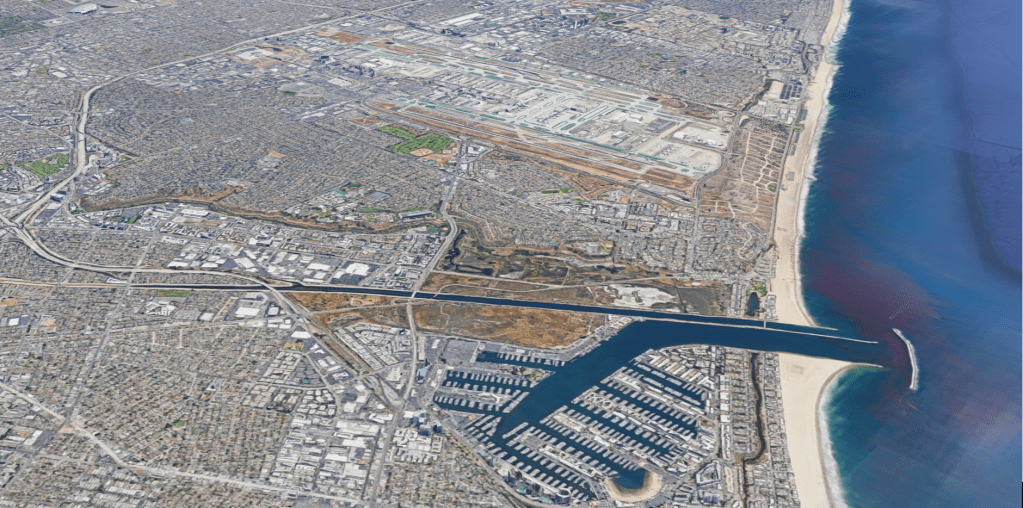
So humans indeed loom large in the story of these wetlands, or what little is left of them: a measly 600 acres of what was once a mighty watershed of 14,000 acres of wetlands across the LA Basin.[1] The two official agencies in charge of the Ballona Wetlands, the California’s Department of Fish and Wildlife and the U.S. Army Corps of Engineers, want to do a large-scale “ecological restoration” of the Ballona Wetlands. The bureaucrats and their environmentalist allies also have a master plan ready to go. Other environmentalists are fighting them in court because they want to protect and heal the place in different ways. A complicated story.
Artists and environmental humanitarians are discovering yet other meanings at Ballona, recording its sounds in the marshes and taking pictures at dawn and dusk and even outside the golden hours of the day. A lot of people are simply spending time and making memories in and around Ballona, walking, running, and biking along its dirt trails and concrete paths. Parts of the protected reserve are open to the public, others locked behind gates. Local academics, meanwhile, are finding Ballona to be a perfect place to call for “multi-species justice” – a term used to further decenter environmental justice and take it beyond the stories of racism that dominate so much of this country.[2] For the sake of all that is alive, the human race needs to find new, more symbiotic ways of being in this world.[3]
It’s not entirely clear where the name “Ballona” comes from. When you type “Ballona” and “meaning” into Google, the search engine’s top guess is that you are researching baby names, telling you that “Ballona as a girl’s name is of Latin origin, and the meaning of Ballona is ‘goddess of battle.’” Second, it will tell you that “Ballona is a geographic place name in the Westside region of Los Angeles County, California.” Third, it brings up a quote by local historian Julie Lugo Cerra, a descendant of the original Spanish colonizers, who writes that
“Ballona Creek, originally, was a picturesque natural waterway fed by runoff. The creek collected the water from cienegas (swamps) and the rains. The banks of Ballona Creek were lined with trees, like sycamores, willows and tules, and even in my dad’s time, (1908-1987), he remembered the watercress growing at its edge.” (https://ballonacreek.org/history/).
Fourth, it brings up the following entry by the local Ballona Creek Renaissance non-profit:
“How did Ballona Creek get its name? No one knows for sure. Some say it’s a misspelling of the Spanish word for “whale” (“ballena”). Others that it refers to a place in Spain where some settlers had roots. Another relates it to the Spanish word for ‘bay.’ The name has been applied to the original Spanish land grant for the local area called Rancho La Ballona. The name has also been used for the wetlands, the valley, and other places.” (https://ballonacreek.org/f-a-q/).
The area had historically been inhabited by the native Gabrieliño-Tongva tribes. During colonization, the Spanish and Mexican governments awarded the land to the Machado and Talamantes families to graze their cattle on, with the Alta California governor confirming the area surrounding the Ballona Creek Watershed as the Rancho La Ballona in 1839, encompassing 13,920-acres. The ownership rights were later confirmed by the California state government.
The image below is a crop from a USGS Topo Map showing the location of Port Ballona relative to the La Ballona Rancho in the year 1896. This area is now the location of Playa del Rey, Marina del Rey, and the Ballona Wetlands.

Source: MoyeWicks, CC.
Today, the less than 600 acres that remain as the highly degraded “Ballona Wetlands Ecological Reserve”, still make Ballona Los Angeles’ second largest public open space after Griffith Park – even if few outsiders have ever even heard of it. Until recently, Griffith Park was home to P-22, the world’s most famous mountain lion who was euthanized last year after largely peacefully co-habiting with humans in LA’s North-Eastern urban wilderness for over a decade, trapped in by a network of freeways he once miraculously crossed at a young age. Ballona is a much quieter attraction. No apex predators have been spotted here in modern days other than humans. Nevertheless, this little complex slice of nature is choke full of stories.
Ballona remains an important resting place for migrating birds and habitat for a multitude of other non-humans that fly, hop, skip, slither, dig, grow, prey, and procreate there – from Great Blue Heron, Burrowing Owl, and Snowy Egret to Grey Foxes, Striped Skunks, Legless Lizards and Slender Salamanders – which is why it’s a place that politicians and bureaucrats now want to “restore”.
“Ecological restoration” is an amazing, grand, well-meaning but also an infuriating concept. It’s all about humans “repairing” nature — since we’ve damaged so much of it so thoroughly during the Industrial Age. The United Nations officially declared the 2020s the “UN Decade of Ecosystem Restoration,” issuing a world-wide call to assist “in the recovery of ecosystems that have been degraded or destroyed.” Nature.com tells us that “ecological restoration aims to recreate, initiate, or accelerate the recovery of an ecosystem that has been disturbed.”[4] At Ballona, the disturbances initially came in the form of grazing cattle, lima bean and celery fields, then bird hunters, beachgoers, a failed wharf, a new Red Car line, road building, oil drilling, dredging, cementing and other hydrological alterations. Some horse stables remained adjacent to the marsh until the end of the 1980s. In 1940, the legendary Howard Hughes spent half a million dollars to establish an airport and an aircraft factory in the area North of Lincoln Boulevard, building his famous wooden Spruce Goose airplane there. Another precious 900 acres of salt marsh were destroyed in the 1950s and 60s during the construction of the Marina del Rey small craft harbor, one of the largest of its kind in the world. During its creation, 3.5 million cubic yards of dredged fill were dumped on some of the remaining portions of the wetlands. Begun in the 1950s, the harbor was dedicated on April 10th, 1965.
Development raged on as Los Angeles transformed itself yet again. On the site of the former Hughes airfield arose Playa Vista, a master-planned New Urbanist community with an adjacent tech campus. The old Spruce Goose hangar became Google’s new wooden cathedral in the center of Silicon Beach, the helicopter hangar next door is now a YouTube Space. The development of this mixed-used site was hugely controversial, however, as the ecological value of the wetlands was being increasingly recognized. Let’s also not forget that sacred indigenous burial sites were violated in the development of Playa Vista – lots of human remains were found during the construction process. It’s clearly been a busy century full of continuous disturbances for Ballona.
One of the most influential environmental groups, the Friends of Ballona Wetlands, was founded in the 1970s by Ruth Lansford. The group was at the forefront of the litigation against several developers and the California Coastal Commission, ultimately reaching an agreement with the Playa Vista development and the State of California to permanently preserve just 600 acres of what used to be well over 2,000 acres. The purchase was done with Trust for Public Land. Depending on your standpoint, you can interpret the fact that environmentalists managed to save the 600 acres west of Lincoln Blvd as a happy ending – or a cynical one. It’s the area most impacted by gas pipelines, old oil wells and other infrastructure from SoCal gas so least suitable for development and thus easier to leave alone for the developer. Bowing to Friends of Ballona activism, the developers also turned a former celery and lima bean field into a new freshwater marsh to contain and clean runoff from the Playa Vista development and adjacent areas. This gave Playa Vista additional opportunity to bill itself as a ‘sustainable development.’
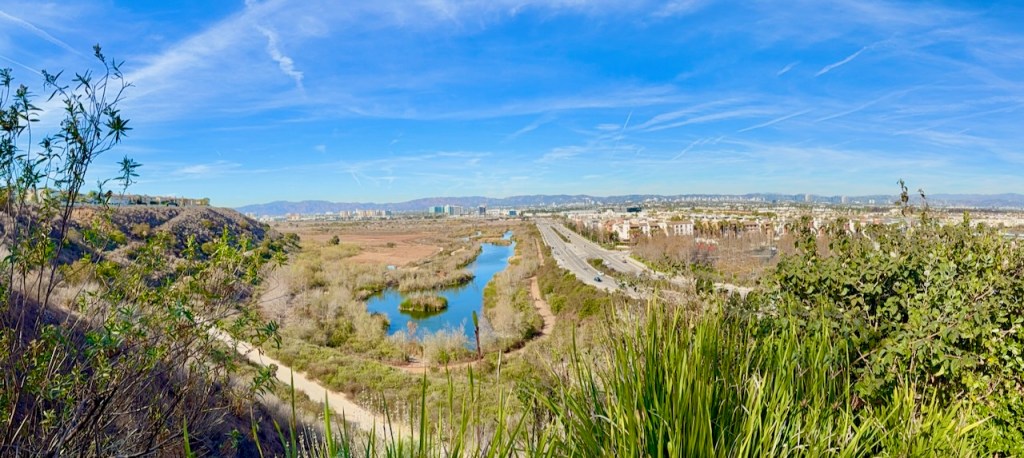
Image of the Ballona Freshwater March (c) Deike Peters
As Angelenos are now contemplating the past, present, and future of what is left of Ballona, we are realizing that it is unclear which “nature” we seek to restore there… Getting back to the wrong nature has of course been a thing ever since Bill Cronon’s (1995) elegant trouble with wilderness. “Nature” is becoming an elusive thing. Can and should humans bulldoze these degraded urban-adjacent places “back” into shapes and sheens that increase ecological diversity and beneficial functions for the settlements we established next door?
The anthropocentrism is painfully obvious, of course. Let’s get out the bulldozers and whip what’s left of this sorry last piece of wetland back into a place that can better protect us against flooding and sea level rise and all those other pesky “natural” disasters in our future. And then, while we are at it, add a bunch of new hiking and biking paths — and also some new parking spaces for the recreators and some observation decks for the birders. This is still man dominating nature, yet this time he is covering his iron fists with green velours and hyping the to-be revamped muddy saltflats as a welcome Kneipp treatments for body, soul, and society. It’s not even a “bad” thing. Ecological restoration is the preferable flip side and tail end of our late industrial age. Yet it is still based on the fundamental misunderstanding that we are separate, above, next to, superior or even just different from the non-human world. A more-than-human perspective requires us to acknowledge that “nature” is not something out there. Equally importantly, ecosystems are never static or fixed in time. Human’s excessive burning of fossil fuels over the course of the past century has now invariably altered the earth’s climate to the point where sea levels are rising, weather patterns are changing, and people feel that “nature” is “behaving” in seemingly ever more extreme and unpredictable ways. But “nature” has a long history of “misbehaving.” The water in a river will find its way from its source to the ocean, but that water won’t flow evenly, steadily, nor will it even follow the same path over time.
The original watershed had seen meandering and changing flows for both Ballona and Centinela creek. The Ballona Creek was once a tributary of the Los Angeles River. In 1825, the LA river naturally changed course and started flowing towards San Pedro (again) instead. This made Ballona a distinct waterway. As Los Angeles’ population grew and many lives were lost in the devastating 1938 flood, humans spent the next 20 years putting a concrete barrier between themselves and their main river. Ballona Creek, meanwhile, had already been channelized by the US Army Corps of Engineers between 1935 and 1939.
Under the current ecological restoration plan, only a very small portion of the creek would be freed from its current concrete straitjacket and allowed to meander again. Humans want to remain in control of the water flows via various flood gates across the reserve.
As is typical for coastal areas with tidal influence, Ballona contains a complex mix of different wetland habitats such as brackish and freshwater marshes as well as riparian and upland habitats including coastal sage scrub and sand dunes, with many birds and other wildlife depending on more than one habitat type. The heterogeneous biodiversity is considered valuable despite the site’s degraded state. What different groups of righteous environmentalists fight over, then, is whether the area should be bulldozed “back” (?) into a full tidal wetland and whether this would constitute an appropriate “restoration.”
In 2015, a group of advocates formed the Wetlands Restoration Principles Coalition to collaboratively advocate for and support such a “most restorative” alternative: Friends of Ballona Wetlands, Heal the Bay, LA Waterkeeper and Surfrider Foundation. All these groups then sent representatives to speak up in support of the Draft Environmental Impact Statement released in September 2017, supporting the vision for a maximized tidal wetland solution. The Final Report which was published by the CA Department of Fish and Wildlife (CDFW) in 2019 follows this recommendation for a maximal solution. Per the official approved summary of the Ballona Wetlands Restoration Plan, however, the project is ”a science-based restoration, enhancement, and establishment of native coastal wetland and upland habitats that will restore the damaged and degraded Ballona Wetlands Ecological Reserve (BWER) to a thriving wetland for listed and other native species, and for the enjoyment of all Angelenos.” Specifically, the California Department of Fish and Wildlife proposes a phased approach to increase about 200 acres of coastal wetlands and to replace 9,800 feet of existing levees with “transitional zones” and to realign the existing, channelized creek, thus reestablishing a floodplain with improved tidal circulation. The project also contains a significant public access component, proposing to install about 5.5 miles of new trails for pedestrians and two new bike and pedestrian bridges as well as two thousand linear feet of elevated boardwalks so that visitors can “walk adjacent to the wetlands and obtain closer habitat views.”
It is a cost-, labor, and time-intensive plan that will impose a thoroughly human-dominated version of “nature” on the site. As Marcia Hanscom of the non-profit Ballona Institute noted: “After they dig it all up and then put it all back together in a new way, it’ll look like a coastal Disneyland project designed for humans, not the wildlife clinging to existence there.”[5] Nature would not be allowed to reestablish itself without human oversight, as new engineered levees would be set back and new hydraulic structures would control the tidal exchange with the southern and southeastern portion of the wetlands area B while a newly constructed retention basin would protect adjacent neighborhoods from flooding.
A key moment in the controversy over the restoration was the public comment period of the DEIR in 2017 when various local environmental groups and activists officially divided into supporters and detractors of the project. On a superficial level, camps may have seemed merely into a pro-bulldozer and a no-bulldozer and a pro-full tidal and a pro-freshwater camp, the full range of commentary included many other aspects, including Playa Vista residents who were concerned to hear about the actual height of the berms to be sculpted and local Playa del Rey business owners fearing that years of heavy construction would adversely affect their establishments and create traffic nightmares. Overall, there was a lot of well-informed citizen questioning and advocacy and the oral public commentary on November 8, 2017 extended over a period of over three hours.[6] A key critique reiterated again and again was that over the course of the 12-years of developing this project, none of the official Four Alternatives presented included a seasonal freshwater solution. Many critics felt and still feel that an updated project should incorporate newer insights into the historical hydrology of the site and recent climate projections into the plans.
There are a number of accomplished ecologists, foremost among them restoration expert Margot Griswold who did a lot of public outreach and education to explain why they felt that the proposed alternative does not really merit the categorization of ‘restoration’. Dr. Griswold argues for accelerated ecosystem recovery instead of “restoration”, insisting that restoration is not at all about trying to get back to some prior, idealized natural state. As the Society for Ecological Restoration’s website notes:
The goal of ecological restoration is to return a degraded ecosystem to its historic trajectory, not its historic condition. The ecosystem may not necessarily recover to its former state since contemporary ecological realities, including global climate change, may cause it to develop along an altered trajectory, just as these same realities may have changed the trajectory of nearby undisturbed ecosystems. History plays an important role in restoration, but contemporary conditions must also be taken into consideration.[7]
The project should also not generically copy previous wetland restorations along the coast, either, because local conditions were unique. According to recent research on the historical ecology of the watershed, Ballona was never a full tidal wetland, yet this is what the major project proposes. It was closed most of the time, only with high runoff from creek so that the dune system would break through to the ocean. This, together with the expected sea level rise over time, is why many ecologists argue that restoration of more freshwater areas is preferable.[8] Opening key areas to tidal flows will not protect all existing species against sea level rise and if mud flats just take over with sea level rise, this would be problematic to specifies like the savanna sparrow. In terms of “ecological value” there is also interesting new science arguing that the full tidal wetland would have much greater carbon sequestration than the current “degraded” wetland since there would be removal of still-functioning soil with great fungi interactions.[9]
There are yet others who are cynical and suspicious about all human interventions and interactions with this battered piece of earth. For one, Ballona is still crisscrossed by gas pipelines and home to many underground gas storage wells as SoCal Gas operates a major facility at the wetland’s edge. The Final Environmental Impact Report envisions SoCal gas permanently sealing and removing sixteen wells from the reserve (and then drilling six replacement wells within the Playa del Rey storage facility area).[10] Another major environmental impact has been imposed on the area by LA’s rampant housing crisis. For several years, a large number of RVs were parked all along Jefferson Boulevard at the boundary of the Ballona Freshwater Marsh, offering shelter to those who could not afford housing elsewhere. The accompanying tent encampments extended inside the public trail of area. Many of these residents cared as much for the nature and wildlife around them as the activists,[11] but the marsh saw brush fires, dumped septic tanks, tossed needles and more. A clean-up effort in early 2023 yielded 19 tons of debris, 200lbs of which were classified as toxic and hazardous materials, including many needles.[12] So the new slice of restored nature that Friends of Ballona and many other agents worked so hard to create 20-years ago has been seriously impacted by the larger human crisis in our city.
So what is a defensible “more-than-human” perspective here? Whose preferred habitat are we recreating and of the various threatened species who will benefit from which conditions the most? Should we argue for maximal intervention or maximal retreat – or is there a Middle Way? I don’t mean to be cheeky. There are no easy answers here. Purporting to tell the tale of a complex, decades-long restoration effort in a few thousand words is an incredibly arrogant idea. So many people have given much of their heart and soul to protect and restore this place. There is no simple master narrative, but we also cannot get hung up in the twists and turns of the story to the point where all relationships become a bundle and then a burden.[13] Many Angelenos have sincerely cared about and for Ballona. Some have faith in the power of iron caterpillars while others work tirelessly towards a cease and desist. Some want to keep the fences around it closed while others tout the beauty of opening up corners of the marsh for our schoolchildren to learn about natives and invasives. Some can’t wait to uproot all the newcomer plants and creatures while others are willing to be selective about it. Some are righteous but use the wrong science (yes, there is such a thing), yet others misuse good science in the name of misguided activism – and all of it happens while the sounds of Ballona carry on but can rarely make themselves heard.
It would be nice to let Ballona speak for itself.
Yet the sounds of Los Angeles drown out much of the sounds of Ballona. Except for those sleepy early or late hours deep inside the marsh, human noise mostly dominates the landscape. Sounds are not solutions, either, of course, but they add to the story.
“Restorying Ballona” is a preposterous idea, of course. We name places, quite awkwardly at times, maybe after giant fish that breathe air, or after a place our great-grandmothers left behind, or after a sound from another language our ancestors spoke. Then we carry on with yet more words to spin their tales while the narrative unfolds. Sometimes we resort to Old Latin to get the naming and categorizing right. In the meantime, human deeds and stewardship and ownership rights of that place may change while water levels fall and then rise. The place, Ballona, heaves and rises and sinks as we extract from it, drill it, drench it, dig it, sample it, berm it, uproot it, plug it, – but oh, we can’t just be (in) it.
Bibliography
Cronon, William J. 1995. “The Trouble with Wilderness; or, Getting Back to the Wrong Nature.” In Uncommon Ground: Toward Reinventing Nature, 69–90. New York: W. W. Norton & Co.
Erika Smith. 2021. “Trash, Needles and Fire. He’s Watching Homelessness Destroy the Ballona Wetlands.” Los Angeles Times, June 17, 2021, sec. California. https://www.latimes.com/california/story/2021-06-17/hes-watching-la-homelessness-destroy-ballona-wetlands.
Friends of Ballona Wetlands. 2023. “The Freshwater Marsh Comprehensive Cleanup – A Step In The Right Direction.” January 25, 2023. https://www.ballonafriends.org/newsandhighlights-articles/2023/1/25/the-freshwater-marsh-comprehensive-cleanup.
Heise, Ursula K., and Jon Christensen. 2020. “Multispecies Justice in the Wetlands.” Ecozon@: European Journal of Literature, Culture and Environment 11 (2): 169–77.
Margulis, Lynn. 2000. Symbiotic Planet: A New Look at Evolution. 1st ed. Science Masters. New York: Basic Books.
Masters, Nathan. 2012. “The Lost Wetlands of Los Angeles.” KCET. February 29, 2012. https://www.kcet.org/shows/lost-la/the-lost-wetlands-of-los-angeles.
Sahagún, Louis. 2019. “‘Coastal Disneyland Project’? Groups Debate Plan to Restore Ballona Wetlands.” Los Angeles Times, December 23, 2019, sec. Climate & Environment. https://www.latimes.com/environment/story/2019-12-23/ballona-wetlands-restoration-plan-conservationists-split.
Society for Ecological Restoration. n.d. “What Is Ecological Restoration?” Accessed August 25, 2023. https://www.ser-rrc.org/what-is-ecological-restoration/.
Vaughn, K. J., Porensky, L. M., Wilkerson, M. L., Balachowski, J., Peffer, E., Riginos, C., and Young, T. P. n.d. “Restoration Ecology.” Nature Education Knowledge 3 (10): 66.
[1] See, for example, Masters (2012).
[2] See (Heise and Christensen 2020)).
[3] On the subject of evolution and symbiosis, please read Lynn Margulis (2000). “When science and culture conflict, culture always wins. Evolutionary science deserves to be much better understood. Yes, humans have indeed evolved, but not just from apes or even from other mammals. We evolved from a longline of progenitors, ultimately from the first bacteria. … All life, we now know, evolved from the smallest life-forms of all, bacteria. … Symbiosis led first to the evolution of complex cells with nuclei and from there to other organisms such as fungi, plants and animals.” (p.4-6)
[4] See Vaughn, K. J. et al. (2010:66)
[5] As quoted in Sahagún (2019), see https://www.latimes.com/environment/story/2019-12-23/ballona-wetlands-restoration-plan-conservationists-split
[6] (Vaughn, K. J. et al., n.d.)
[7] See Society for Ecological Restoration (n.d.) at https://www.ser-rrc.org/what-is-ecological-restoration/
[8] This point is additionally supported by recent studies that looked at the change in lagoon habitat types elsewhere along the California coast, especially North San Diego County. They show a huge increase in open water mud flat while salt flats and marsh and brackish water have decreased. Jettied open restorations also come with permanent, costly maintenance issues due to sedimentation. This is most dramatically the case at another wetlands restoration project a bit further down the coast at Bolsa Chica in Huntington Beach.
[9] And in terms of biodiversity comparisons, it is not fair to equate the improve project with a “no project/no management” alternative, which is not what the more serious restoration ecologists want for the area, either. They just don’t want the extensive bulldozing and disruptive earth moving. They claim that there can be lots of management with available hydrology.
[10] See SoCalGas (n.d.)
[11] See, for example, Smith (2021)
[12] See Friends of Ballona Wetlands (2023)
[13] Once, again, please remember what the brilliant, renegade scientist Lynn Margulis, taught us, namely that “symbiosis, which simply means members of different species living in physical contact with one another, is crucial to the origins of evolutionary novelty.” (From the (paper) back cover of Symbiotic Planet.)
 The Spliced City
